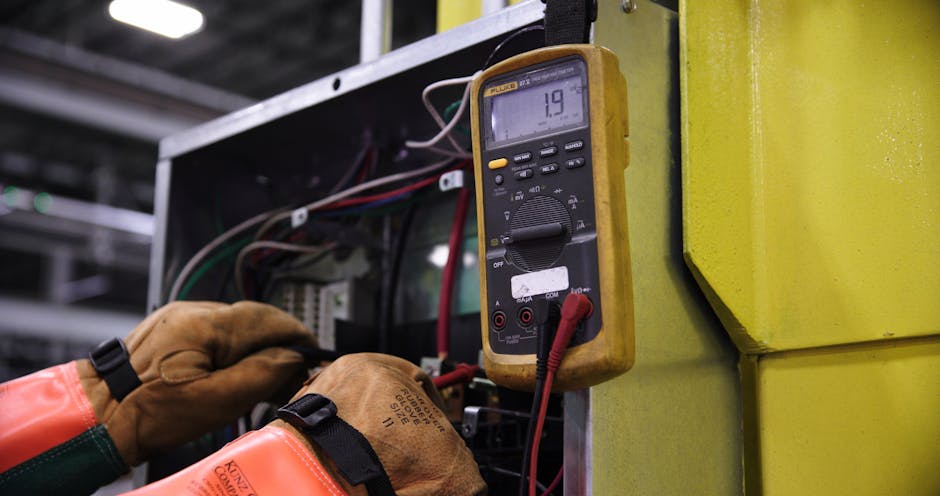
If you manage a commercial property in North West England, staying on top of your electrical testing and inspection schedule isn't just good practice – it's a legal obligation. Over 25 years of working with facilities managers, landlords, and business owners across Cheshire, Greater Manchester, and Merseyside, I've seen first-hand how a well-planned testing regime prevents costly shutdowns, protects occupants, and keeps businesses on the right side of the law. Yet it remains one of the most commonly overlooked aspects of property management.
Here's a practical, no-nonsense guide to getting your testing schedule right.
Why Electrical Testing Matters for Commercial Properties
Commercial and industrial electrical installations are subject to far greater demands than domestic systems. Higher loads, more complex distribution boards, machinery, three-phase supplies, and constant use all contribute to accelerated wear. Faulty wiring, degraded insulation, loose connections, and overloaded circuits don't always announce themselves with obvious warning signs – but they remain one of the leading causes of commercial fires in the UK.
Under the Electricity at Work Regulations 1989 and the Health and Safety at Work Act 1974, duty holders are legally required to ensure that electrical installations are maintained in a safe condition. The BS 7671 Wiring Regulations (18th Edition) set out the technical standards, while guidance from the IET recommends specific testing intervals based on premises type. Failure to comply can result in enforcement action, insurance claims being rejected, and – in the worst cases – prosecution following an incident.
Understanding the EICR: Your Primary Compliance Tool
The Electrical Installation Condition Report (EICR) – sometimes still referred to as fixed wire testing or periodic inspection – is the formal assessment of your installation's condition. Carried out by a qualified electrician (ideally from an NICEIC-approved contractor like DRM Electrical), it involves a thorough visual inspection and a programme of testing across circuits, distribution boards, earthing, and bonding arrangements.
The report classifies any defects using a standardised coding system:
- C1 (Danger present) – Immediate risk requiring urgent action
- C2 (Potentially dangerous) – Requires remedial work as a priority
- C3 (Improvement recommended) – Not immediately dangerous but worth addressing
- FI (Further investigation) – Additional testing needed to determine the issue
An installation receiving any C1 or C2 codes is classified as unsatisfactory. As a duty holder, you are legally obligated to address these defects promptly. We regularly carry out EICRs for warehouse units in Warrington, office blocks across central Manchester, and retail premises throughout the Wirral – and it's not uncommon to find C2 defects that have gone undetected for years.
Recommended Testing Frequencies by Premises Type
The IET Guidance Note 3 sets out recommended maximum intervals between inspections. Here are the key ones relevant to commercial and industrial property managers:
- Commercial offices and shops: Every 5 years
- Industrial installations: Every 3 years
- Leisure facilities, hotels, and public houses: Every 5 years (or 1 year for some areas)
- Places of public entertainment (cinemas, theatres): Every 1–3 years
- Agricultural and horticultural premises: Every 3 years
- Caravan parks and marinas: Every 1 year
- Special installations (petrol stations, construction sites): Every 1 year or at change of occupancy
It's important to note that these are maximum recommended intervals. If your installation is older, subject to heavy use, or operating in a harsh environment – as many industrial units across Greater Manchester and Cheshire are – more frequent testing may be warranted. Your NICEIC-approved inspector should note the recommended next inspection date on the EICR itself.
Beyond the EICR: Other Testing You Shouldn't Overlook
The EICR covers the fixed wiring installation, but a comprehensive electrical maintenance programme extends further:
- Portable Appliance Testing (PAT): While not a specific legal requirement in its own right, the duty to maintain equipment in a safe condition effectively makes PAT testing essential. Frequency depends on the environment – annually for most commercial premises, more frequently in industrial settings.
- Emergency Lighting Testing: BS 5266 requires monthly functional tests and a full three-hour duration test annually. We see this missed regularly on multi-tenanted sites across Merseyside where responsibility for common areas is unclear.
- Fire Alarm System Testing: Weekly call-point tests and six-monthly professional inspections under BS 5839 are essential and often tied to your fire risk assessment.
- RCD Testing: Residual current devices should be tested quarterly by pressing the test button, with formal testing as part of the EICR cycle.
- Thermal Imaging Surveys: Particularly valuable in industrial panel boards and large distribution systems, thermal surveys detect hotspots caused by loose connections or overloaded circuits before they become failures.
Building a Practical Testing Schedule
The most effective approach I recommend to facilities managers is to create a single electrical compliance calendar that brings all testing requirements together. Here's how to start:
- Audit your current documentation. Locate your most recent EICR, PAT records, emergency lighting certificates, and fire alarm service reports. If you can't find them, that's your first red flag.
- Note expiry dates. Work backwards from the next EICR due date and schedule remedial works, PAT testing, and emergency lighting checks to avoid everything falling due simultaneously.
- Assign responsibility clearly. On multi-tenanted commercial sites – common across business parks in Trafford, Stockport, and Chester – define exactly who is responsible for shared areas, risers, and incoming supplies. Ambiguity here leads to compliance gaps.
- Use an NICEIC-approved contractor. This guarantees that testing is carried out to the required standards, that certificates are properly issued and registered, and that your insurer and local authority will accept the documentation without question.
- Keep digital records. Paper certificates get lost. Maintain scanned copies centrally and share them with your insurance broker proactively.
A Note on Change of Tenancy
If you're a commercial landlord, an EICR should be carried out at every change of tenancy – regardless of when the last one was completed. This protects both you and your incoming tenant, establishes a clear baseline, and is increasingly being requested by commercial solicitors during lease negotiations.
The Cost of Getting It Wrong
We were recently called to a food production facility near Ellesmere Port where the EICR had lapsed by over three years. During our inspection, we identified multiple C1 and C2 defects including deteriorated armoured cable entries, a distribution board with evidence of overheating, and absent circuit protective conductors on several final circuits. The client faced not only the cost of urgent remedial works but also a risk of enforcement action from the HSE and potential issues with their food safety accreditation. A scheduled, proactive testing programme would have identified and resolved these issues incrementally, at a fraction of the cost and disruption.
Keeping your electrical testing and inspection schedule current is one of the most straightforward ways to protect your property, your people, and your business. If you're unsure whether your commercial or industrial premises are up to date – or if you'd like a no-obligation review of your current compliance position – DRM Electrical is here to help. As an NICEIC-approved contractor serving businesses across Cheshire, Greater Manchester, and Merseyside, we provide clear reporting, expert remediation, and ongoing support to keep you fully compliant.
DRM Elec
NICEIC Approved Industrial & Commercial Electricians
Get a Free Quote
Ready to discuss your electrical project? DRM Electrical Services has over 25 years experience serving the North West.
Get a Free Quote